



Prada Acquires Versace: A New Era in Luxury Fragrance
Introduction
Prada’s 1.25 billion purchase of Versace is more than a shift in fashion power. It also has deep implications for the luxury fragrance and beauty sector, where both houses operate major global licensing deals.
This move challenges the long-standing dominance of LVMH and Kering, while signaling Prada’s intent to expand from couture into fragrance ownership and beauty infrastructure.
With this deal, Prada can streamline Versace’s bold fragrance catalogue, tighten control over brand positioning, and unify Italian luxury identity under one umbrella, reshaping how perfumes are created, distributed, and sold worldwide.
Understanding the Timeline: From Idea to Deal

| Date / Period | Event | Summary |
|---|---|---|
| Late 2024 | Tapestry (Owner of Coach) : Capri Holdings terminated merger agreement | Federal Trade Commission decision triggers Capri to explore divestments. |
| Jan-Feb 2025 | Prada enters preliminary talks | Prada gains preferential access to Versace’s financials. |
| Mar 2 2025 | Reuters reports : 1.5 billion talks | Negotiations accelerate; valuation expected around $1.6 B. |
| Mid-Mar 2025 | Donatella Versace steps down | Dario Vitale (ex-Miu Miu) appointed Creative Chief. |
| Apr 10 2025 | Definitive agreement signed | Prada to acquire 100 % of Versace for 1.25 B. |
| Apr-Sep 2025 | Regulatory review phase | EU approval granted Sept 30 2025; closing expected Q4. |
It was also worth noting that Capri Holdings enlisted Barclays to find a buyer for both Versace and Jimmy Choo, which resulted in the interest of Marco Bizzari (former Gucci CEO) and Primavera Capital Group. One Reuters report noted that some market watchers expected a price closer to $1.6B, but adjustments pushed the final valuation down.
The fact that the acquisition occured after Versace’s declining revenue of 15% in Q3 fiscal 2025 and Prada’s double-digit growth across business lines, demonstrates calculated dealcraft, creative succession planning, and strategic timing rather than a hostile takeover.
Business Models Before & After the Acquisition
Prada (Pre-Acquisition)
- ~88 % of revenue from direct retail; minimal reliance on wholesale.
- Entered the fragrance category in 2003 with Puig; in 2023 launched Prada Beauty with L’Oreal Luxe.
- Focused on tight control of pricing, distribution, and marketing to protect brand value..
Versace (Pre-Acquisition under Capri Holdings)
- Broad wholesale network + licensing across fragrances, eyewear, and accessories. Operated a large licensed fragrance business with Euroitalia.
- Relied on wide international distribution, often through multi-brand perfumeries and duty-free retailers.
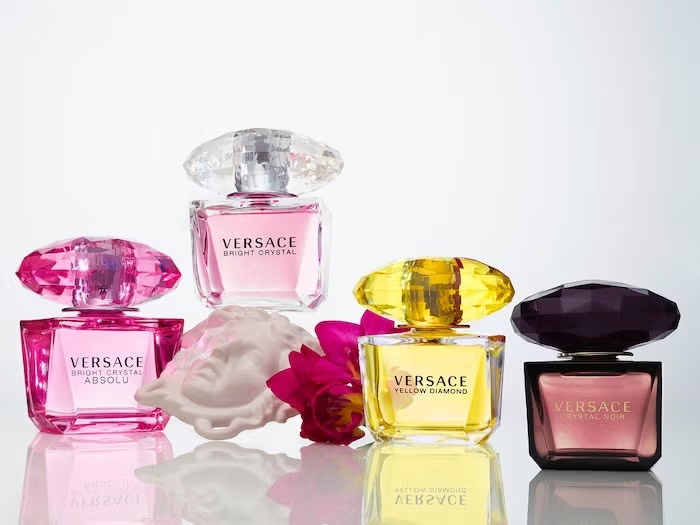
- Supported a mix of mass-appeal scents (e.g., Eros, Dylan Blue, Bright Crystal) and prestige fashion launches.
Post-Acquisition Outlook
- Prada is expected to evaluate or restructure Versace’s licensing with Euroitalia, possibly integrating it under L’Oreal Luxe or internalizing future launches.
- Versace fragrances could shift toward fewer, hero lines with stronger creative storytelling and packaging coherence.
- Retail and distributor access will likely become more selective, reflecting Prada’s vertically controlled model.
- Prada’s growing beauty division may use Versace’s fragrance reach to expand across new regions while reducing price overlap and gray-market exposure.
Why This Acquisition Matters

Power Shift in Luxury Fragrance
This acquisition gives Prada leverage to compete directly with LVMH (owner of Dior and Givenchy fragrances) and Kering Beauty (Gucci Beauty).
It positions Prada as a major Italian beauty and fragrance house, capable of producing and managing multiple prestige brands from design to bottle.
Industry Implications
- Consolidation of licensing power: As Prada integrates Versace, expect tighter control of licensing, regional exclusivity, and brand storytelling.
- Pressure on independent perfume groups: Houses relying on licensed Italian brands may face contract changes or terminations.
- Rise of vertically integrated beauty: Prada follows LVMH’s model of keeping fragrance production closer to the parent company for quality and consistency.
For Consumers and Collectors
- Hero lines like Versace Eros or Dylan Blue may be reformulated, re-packaged, or re-positioned as ultra-luxury editions.
- Expect more limited drops and stronger links between runway themes and perfume storytelling.
Impact on Retailers & Wholesalers

For Wholesalers and Distributors
- Tighter allocations: Prada’s selective distribution model will reduce open-market flow and parallel trade availability.
- License realignment: Contracts with Euroitalia or third-party distributors may be renegotiated; volume-based agreements could shrink.
- Shift to premium assortment: Emphasis on fewer, high-margin SKUs rather than full catalog distribution.
- Increased compliance checks: Prada will likely track international resale channels more strictly to prevent price erosion.
Tips for Wholesalers
1. Build early contact with Prada or Euroitalia transition teams
Establish communication early with the transition teams handling Versace’s fragrance operations. This will help you anticipate upcoming changes in pricing, logistics, and product availability, positioning your company as a reliable, proactive partner during the handover.
2. Focus on maintaining regulatory compliance
Prada is known for its strict operational standards, so ensure your business meets all IFRA, CPNP, and packaging traceability requirements. Being audit-ready shows credibility and helps maintain long-term trust as the group refines its distribution network.
3. Keep track of sell-through and customer data
Collect clear data on fragrance sell-through rates, reorder frequency, and customer demographics. Sharing these insights strengthens your position as a value-adding partner and helps brands understand your market’s true performance potential.
4. Diversify your portfolio strategically
Balance your inventory by adding niche or K-beauty fragrance brands that complement your luxury lineup. This protects your business from allocation cuts during the transition and broadens your appeal to retailers seeking fresh, high-margin scents.
For Fragrance Retailers
- Selective product access: Expect curated launches and reduced bulk availability for discount or parallel channels.
- Repositioned pricing: Prada is likely to push Versace’s prices slightly higher to align with luxury positioning.
- Demand for stronger in-store storytelling: Visual merchandising and staff training will be key for maintaining sell-through on elevated lines.
- Online-to-offline balance: More emphasis on flagship store exclusives and limited online pre-orders.
Tips for Retailers
- Keep Versace’s hero lines visible
Continue highlighting core fragrances like Eros, Dylan Purple, and Bright Crystal as reliable anchors in your assortment. These lines will remain key entry points for consumers during the transition and can help sustain steady sell-through while new product directions unfold.
2. Refresh in-store presentation
Align your visual displays with Prada’s minimalist and refined aesthetic. Use clean layouts, elevated testers, and premium signage to convey a sense of luxury consistency across both brands. This signals professionalism and helps maintain brand approval for future allocations.
3. Strengthen digital storytelling
Enhance your online and social presence with educational content that connects each scent to its story, from ingredients to design inspiration. Short videos, tutorials, or fragrance layering tips can increase consumer engagement and reflect the elevated brand positioning Prada is known for.
4. Stay adaptable with purchasing
Keep your ordering volumes flexible until the new launch rhythm is established under Prada’s management. Smaller, more frequent restocks can help you manage inventory risk while adapting quickly to pricing or assortment changes after integration.
Conclusion
Prada’s acquisition of Versace is a defining moment not just for fashion but for luxury fragrance.
It transforms Prada from a primarily fashion-driven brand into a diversified beauty group with control over both design and scent.
The change will likely bring fewer but more curated perfume launches, tighter global distribution, and stronger protection against market saturation.
For fragrance retailers and wholesalers, this means adapting to a new structure where brand alignment, storytelling, and compliance matter as much as volume.
Those who can provide data-driven insights, maintain premium presentation, and align with Prada’s brand philosophy will remain valuable partners in this new era of Italian-led luxury fragrance.